Showing posts with label World Environment Day. Show all posts

Saturday, June 7, 2008

News from Extension Centres in Chhattisgarh

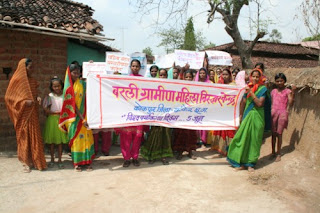
Miss Lata Yadav and Ms Sonwati from Kanker have sent the following news of 2 programmes on World Environment Day organised by the graduates and trainees of Extension Centres of Barli Development Institute for Rural Women Indore, These extension centres are located in tribal areas of Kokpur and Bhandari Para of Kanker in Chhattisgarh .
The participants included Mahila Mandals (Women Groups) from Bewarti, Kokpur Dongripara together where they took out rallies to make people aware of carbon reduction.
In her welcome address Ms. Lata Yadav and Mrs. Santoshi introduced the importance of the World environment day and UNEP they told that it is a day to focus our attention towards the conservation and preservation of environment, “because all of us should feel our moral duty to take care of the environment because it is in our own interest.
She said that we should plant and protect more trees. Panch, Sarpanch, Mahila Mandal Chairperson and Anganwadi worker of Kokpur and Dongripara about 60 women and men participated in each rally that walked through the villages with signs relating to save the environment, no pollution, plant more trees, care for the environment is service to the community, importance of healthy environment and to care for land, water, animals and forest etc.
For a detailed report of activites at Barli Development Institute for Rural Women during World Environment Day visit our web site http://www.barli.org/

Barli Development Institute for Rural Women celebrates World Environment Day 2008

Barli Development Institute for Rural Women observed the World Environment Day 2008 by concluding a three day training workshop for 81 young rural and tribal girls and women from 44 villages in Dewas, Dhar, Jhabua, Khargone, Badwani and Indore districts of Madhya Pradesh
The theme of the workshop: "Reducing Carbon by Changing Habits.”Janak McGilligan Institutes Director in her welcome note shared UNEP’s message to follow the 12 steps to kick the Co2 habit, and to work towards a low carbon economy.
Dr.Prabhakar Pandit organic farming researcher and writer, was the chief guest and Dr. Arun Dike the agricultural scientist presided over this function. Prabhakar Pandit said that he was deeply impressed with the sustainable model of Barli Institute training of grass-root young women who are the real managers of environment in the villages
Dr. Arun Dike highlighted the urgent need to switch over to organic farming and address all the issues relating to carbon reduction. He said he was fascinated with the briquetting, initiative of Barli Institute as one of the most practical, simple and inexpensive solution to reduce carbon.

Miss Pooja Rathore from Khargone spoke about the saving water and reuse of water and she will now always reuse the water after cleaning and mopping in the garden.
Miss Maya from Dewas said that now she understands the merits of organic farming and she will try to practice in her community.
Miss Kamla More from Badwani District explained the meaning of environment and its conservation that she never heard before.
Miss Barkee drew everyone attention to how much trees give us and the time is come for us to protect and save them.
Miss Kiran Chouhan from Khargone district shared information on environment pollutionMrs Neha Kanoje shared benefits of trees.
Miss Idi, Miss Jendoo, Miss Uma and their group composed and sang sons about environmental conservation.
Also present on the Dias were Dr. Anupama Negi, Anaesthesist and counselor for breast cancerMr. Pramod Narayan Kulkarni, Retired Principal, Central School Mumbai,Dr. Geeta Handa ,the organic Chemist and Mr. Jimmy McGillgan Manager of the Barli Institute

During these three days, of the workshop the trainees would learn about the meaning of environment, what is pollution in general and carbon in particular and it’s affect on our lives. They would learn about the dangers of the use and over use of pesticides and other chemicals in agriculture, and when they are used how handle them without damaging their own health.Institute has developed its own training materials written in very simple local language and using the examples from local culture.
There were sessions conducted by the programme officers Ms Archna Margonwaer, Ms Dhedi Dawar, and Ms Noori. Dr. Geeta Handa , who is an organic Chemist, Dr. Anupma Negi an Aneasthesist, Dr. Shakutla Sharma and Aryuvedic practitioner, Mr Narain Prasad Madhup from Kukshi.
They learned about caring for the environment with a focus on role of women, appropriate and sustainable solutions to the current problems of forest degradation, the depletion of groundwater resources and rainfall dependant vegetable gardening.
Methods of how to organically grow dry, process, store and preserve fruits, vegetables, herbs, spices and lentils, rain-water harvesting, reuse of waste water for irrigation, waste management and composting, nursery development and plant propagation.
They also learned about the importance and benefits of solar cooking, especially for women to prevent the daily back-breaking work of fuel gathering and to help to preserve forest and woodlands and while doing so reduce air pollution.
Learning how the trees and plants absorb the pollution and carbon, and to understand that as we breathe out the trees breathe in and as they breathe out we breathe in a cleaner air.
For a full report of activities on World Environment Day visit our web site http://www.barli.org/
Jimmy McGilligan

Wednesday, June 4, 2008

Training workshop for tribal women Inaugurated to mark the World Environment Day


On 3rd June 2008 Barli Development Institute for Rural Women inaugurated a three day training workshop for 80 young rural and tribal girls and women from Dewas, Dhar, Jhabua, Khargone, Badwani and Indore districts of Madhya Pradesh. The theme of the workshop is "Reducing Carbon by Changing Habits” This work shop will conclude on World Environment Day 5th June

The workshop was inaugurated by Professor. Rakesh Trivedi, Environmentalist and professor of Zoology. He said Indore is known as one of the best education centres but Barli Institute is most amazing, being an incredible practitioner, where actions speak louder than the words. Knowledge is applied and has proved to be one of the best Institute for environmental management. He said that Barli is way ahead in reducing carbon and people should learn from here. He explained the meaning and ways to reduce carbon in a very simple way

Experiences of recycling shared by the members of staff, some who were trainees turned trainers. They showed the collection of used and discarded materials, turning them into new products.

Noori the tailoring trainer shared her a full range of eco-friendly products like small bags for mobile phones pouches to gift money/ornaments handbags, and purses, old greeting cards turned into book marks, exhausted dry cell batteries collected and artistically packed to make paperweights, glass holders for drinking hot tea, multicoloured mobiles and hangings all made of cloth scrap after training in cutting and tailoring and knitting etc and beautiful woollen embroidery on rice sacks which are turned into very sturdy and colourful carry bags etc..
Chanda Nikhare who teaches batik and block printing was so proud of showing the briquettes made out of waste paper and dry grasses etc that she uses for melting wax for batik printing, how fallen hair is turned into brushes for painting melted wax on fabric and how she heats the iron to press the finished work on the solar cooker.

Sunderbai from garden staff, showed at least a dozen of organically grown and solar dried vegetables like egg plant, cabbage, cauliflower, fenugreek and herbs like tulsi, turmeric, garlic, lemon grass and many spices, lintels and peas etc. She also shared how they grow all the vegetables and some grains to feed about hundred people throughout the year using, vermiculture, composting of vegetable peels, and other garden and vegetables waste, reuse of wash water and toilet water for irrigation.

Sharmila and Sagri, the solar cooks, explained in detail their cooking experiences in the Institute’s solar kitchen, how it is clean and smoke free, saves money, good for health and is carbon neutral. They also mentioned the use of smaller domestic solar cookers, water heaters and energy efficient light bulbs.

Barli Institute makes sure that as many products as possible are made using bio-degradable materials through innovation and an eco-friendly approach.

Professor A. A. Abbasi, former Vice Chancellor of DAVV University Indore while presiding over said it was the most rewarding experience for him to see the Institute that has created an environment with solar energy so efficiently used here and then the tribal women learn to use it and take to their villages. He commended the vision and dedicated and silent work of Mr. Jimmy McGilligan for his environmental training and untiring efforts is like that of Mahatma Gandhi.

Professor Shirin Mahaltai an economist said that humanity has abused the environment and now we must repair it by making people aware of protecting it. While we only observe Environment Day once a year, we actually need to protect and conserve the environment all year round. Environment Day draws our attention to the importance of the environment and how we have damaged it.

The Director of the Institute, Dr. (Mrs.) Janak McGilligan gave an introduction of the Institute history of the World Environment Day and its importance. She said the Institute has been working on environment education for 23years. She stated that the Institute does not use chemical fertilizers in its field, re-uses water, makes compost, and grows organic food and cooks food on solar for 100 persons during 300 days in a year. The Institute encourages everyone to use of solar energy in cooking. In 1992 Institute was the recipient of UNEPs global 500 Roll of Honour award for its work in the field of eradication of guinea-worms. This work was done in 302 villages of Jhabua district in Madhya Pradesh. The objective of training rural women in environment is aimed at fulfilment of Agenda 21 and Millennium Development Goals.

The program was conducted by Mrs. Dhedi Bagdare and vote of thanks is given by Dr. Geeta Handa.


For More Information on Barli Development Institute for Rural Women see http://www.barli.org/